

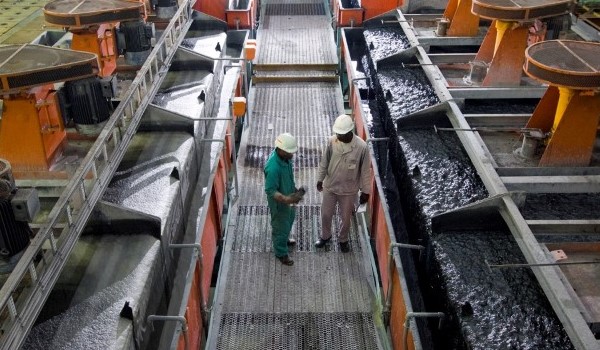
Cornered militarily, weakened politically and limited strategically, the Democratic Republic of Congo seems determined to solicit the United States. Raw materials in exchange for military support. This is what the newspaper Le Monde indicates in an article of March 10, 2025 titled “The United States ready to discuss a partnership on minerals with the DRC”. The French daily emphasizes that “On February 21, a lobbyist representing Congolese Senator Pierre Kanda Kalambayi sent letters to the American Secretary of State, Marco Rubio, and other officials of the Donald Trump administration, inviting the United States to invest in minerals in the DRC in exchange for help in strengthening “regional stability””. From a communication and strategy point of view, this information raises the following questions: When, why and with whom to negotiate?
Before answering these questions, let’s set the context:
The war that has been raging in Congo-Kinshasa since the end of the 1990s is a so-called low-intensity war, which has intensified episodically. The crisis with the M23 armed forces since 2023 is one of these episodes. After rather unsuccessful diplomatic initiatives with regional actors (SADC, EAC) and while the M23 armed forces accumulate territorial conquests in the Congo, the DRC has not managed to provide a military response to this aggression to reverse the balance of power.
When to negotiate?
Given this context, is this negotiation project with the Americans opportune or relevant? In diplomacy, as in other areas, negotiating when you are in a position of weakness is not a strategically relevant approach. But in the current emergency situation in Congo, did the government have a choice, one could retort? Given that the war has been raging since the end of the 1990s, the urgency should be precisely strategic thinking.
To know when to negotiate, you need to be able to have a prospective and proactive approach that consists of equipping yourself with a team and expertise in analyzing not only current events, but also trends and history, to outline scenarios of possibilities.
Wanting to negotiate with the USA today is to send the American power the signal that you are in a situation of vulnerability and fragility. And consequently it can impose all these conditions on you, a bit like this imbalance, can impose its conditions and force you to accept the unacceptable.
It is in this situation of vulnerability that the Ukrainian president found himself in the Oval Office of the White House. And the American president, Trump, made it clear and understood. When to negotiate? The government would have to have accumulated military and diplomatic victories before coming to the negotiating table. When to negotiate? When we manage to weather the storm, when we seize an opportunity before the situation degenerates.
The question of “When” raises the question of anticipation. To know when to negotiate, you need to be able to have a prospective and proactive approach that consists of equipping yourself with a team and expertise in analyzing not only current events, but also trends and history, to outline scenarios of possibilities.
Why negotiate?
The prospective approach and anticipation because they encourage studying the contexts and actors involved are able to provide answers to the question “why negotiate”.
Why negotiate? Because in all cases, we have identified our best alternative to a negotiated agreement or BATNA.
In the case of Congo, negotiation is seen as a preventive tool. Because the goal of negotiation is to help “security” and “regional stability”. From the American point of view, negotiation is very pragmatic, for them it is an opportunity to strengthen and promote national and security interests. It is in this sense that we must understand that “The United States is open to discussing partnerships in this sector that are aligned with the “America First” policy of the Trump administration”.
Why negotiate? For its own interests, certainly. But it is essential to clarify what is meant by interest. If well prepared (foresight and anticipation), negotiation allows for the exploitation of common interests to create value for all parties involved. If well prepared, negotiation allows for the establishment of lasting partnerships, essential for overcoming future challenges and ensuring continued cooperation.
Why negotiate? Because in all cases, we have identified our best alternative to a negotiated agreement or BATNA. The BATNA is the best alternative available in the event of failure of negotiations or if no agreement is reached. In the case of Congo, due to its vulnerable situation, it would seem that it is short of alternatives.
Who to negotiate with?
Communication, like strategy, is inherently cultural. This is why negotiation is also an intercultural process. It is indeed crucial, in a negotiation, to know, understand and master the codes, symbols and contexts of the different stakeholders (oneself) because they shape choices, positions and decisions.
For a negotiation to be relevant and efficient, it is essential to include all key and relevant actors. In the context of the war in Congo and the race for strategic raw materials to dominate the world and the global economy, a negotiation without including China, over the long term, would open the doors to certain tensions in Congo.
In their book “How to become a charismatic and effective leader”, professors Fweley Diangitukwa and Djawed Sangdel focus on the cultural dimension of leadership, in particular by drawing our attention to the mentalities of scarcity and abundance.
“People who develop the mentality of scarcity want to have everything for themselves and little for [others]. We tend to see everything from a ‘winner/loser’ perspective. We have the conviction that things are limited, that if someone has part of it, there will be less for oneself. This is the spirit of ‘winner’ type leaders. The Winner leader is afraid to share his profit fairly with others because he would like to be the only winner in the relationship. This type of leader always thinks that any gain for someone other than him implies a personal loss… On the other hand, people who have an abundance mentality use the principle of ‘win/win’ negotiation and that of communication. » (“How to become a charismatic and effective leader”, Fweley Diangitukwa and Djawed Sangde, Editions Monde Nouveau, pp. 201-202)
The United States and President Trump are rather in a mentality of scarcity, where the DR Congo would position itself more in a mentality of abundance (“The DRC has available reserves and it would be good for American capital to invest here” said the spokesperson for the Congolese government).
With whom to negotiate? Analyzing the actors of the negotiation and their contexts allows us to highlight the white elephant in the room: China. For a negotiation to be relevant and efficient, it is essential to include all key and relevant actors. In the context of the war in Congo and the race for strategic raw materials to dominate the world and the global economy, a negotiation without including China, over the long term, would open the doors to certain tensions in Congo.
Conclusion: Sun Tzu and knowledge
In the art of war, Sun Tzu says this: “He who knows the other and knows himself, in a hundred battles will not be defeated; he who does not know the other but knows himself, will be victorious half the time; he who does not know the other any more than he knows himself will always be defeated.”
For the Chinese philosopher and theorist of the art of war, understanding both one’s own strengths and weaknesses and those of the adversary is essential to developing a winning strategy. In the context of a negotiation, this means that rigorous preparation – that is, a thorough analysis of the interests, positions, identities and contexts of each party – is the key to coming out on top in the negotiation, or at least finding a suitable and profitable common ground.
Written by Esimba Ifonge.